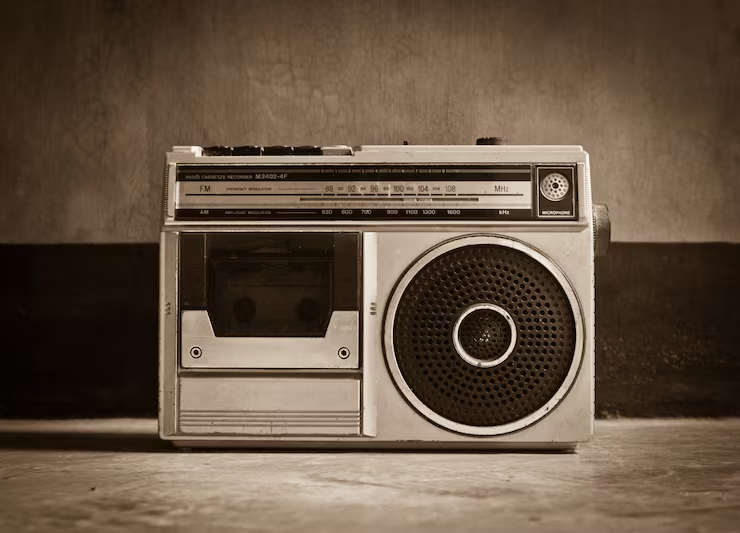
The Impact of Radio on Society
In an age dominated by smartphones, streaming platforms, and social media, it’s easy to overlook one of the most transformative inventions of the last century—radio. But despite being over a hundred years old, radio remains a powerful tool that has significantly shaped communication, culture, and society. From its early days as a scientific curiosity to its role in global politics, entertainment, and emergency communication, radio has left an indelible mark on the world.
The Birth of a Revolutionary Medium
Radio’s journey began in the late 19th century, with pioneers like Guglielmo Marconi, who is often credited with inventing the first practical radio communication system. By the early 20th century, radio was evolving from a tool for ship-to-ship and military communication into a medium capable of reaching the masses.
What made radio revolutionary was its ability to transmit information instantly across great distances. For the first time, people could receive real-time updates on news, weather, and world events without the need for printed material. This had massive implications—not just for communication, but for how society functioned as a whole.
Radio and Mass Communication
Before the internet and television, radio was the first true mass communication medium. It reached millions of people across vast geographies, often simultaneously. This ability to unify people through shared content changed how societies consumed information and entertainment.
1. News and Public Information
During the 1920s and 1930s, radio quickly became a crucial tool for delivering news and public announcements. Political leaders such as Franklin D. Roosevelt used radio to speak directly to citizens in his famous “Fireside Chats,” fostering a sense of intimacy and trust with the public. In times of crisis—such as during World War II—radio served as the primary source of news and official information, shaping public opinion and morale.
2. Cultural Impact and Entertainment
Radio also had a profound impact on popular culture. With the rise of commercial radio stations, audiences were introduced to music, serialized dramas, comedy shows, and variety programs. These broadcasts helped standardize culture across regions, influencing fashion, language, and social norms. The rise of musical genres like jazz, blues, and rock ‘n’ roll can be traced directly to their exposure via radio.
Radio DJs became tastemakers, introducing listeners to new sounds and trends. Shows like The Grand Ole Opry and American Top 40 became cultural institutions that shaped the music industry for decades.
Political Power and Propaganda
Radio’s ability to influence the masses was not lost on politicians and governments. In the 1930s and 1940s, authoritarian regimes such as Nazi Germany used radio as a propaganda tool, broadcasting carefully crafted messages to control public opinion. Similarly, in wartime, Allied and Axis powers used radio to deliver psychological warfare, misinform the enemy, and maintain domestic morale.
In democratic societies, radio became a forum for political discourse and civic education. Debates, campaign coverage, and public service programming increased political awareness and participation. Even today, talk radio remains a powerful medium in shaping public and political attitudes.
Education and Public Awareness
Radio has also been used extensively in education, particularly in rural or underserved areas where access to traditional schooling is limited. Educational programming, language courses, and agricultural information were often broadcast to communities without other forms of instruction. In developing countries, radio continues to play a role in improving literacy, health awareness, and community development.
During global emergencies, like the COVID-19 pandemic, radio served as a vital tool for spreading accurate health information to people without internet access, helping combat misinformation and promote safety measures.
Social Unity and National Identity
One of the most underappreciated aspects of radio is its role in fostering national identity and social unity. Radio created shared experiences—millions listening to the same sports event, concert, or breaking news story at the same time. This collective listening built a sense of community, even among people who had never met.
In multilingual or multicultural countries, national radio stations often use a common language, helping to unify disparate regions and promote inclusivity. Radio is also a medium that can preserve indigenous languages and traditions, broadcasting content relevant to minority populations.
Radio in the Modern Age
With the advent of television in the 1950s and the internet in the 1990s, many predicted the death of radio. However, radio proved remarkably adaptable. Today, it exists in a variety of formats—FM/AM, satellite, internet streaming, and podcasts. In fact, digital transformation has expanded radio’s reach and accessibility.
Streaming platforms and podcasts have brought new life to audio content, allowing people to listen on-demand and connect with niche content creators. Meanwhile, community radio stations remain vital in many parts of the world, especially in remote or conflict-prone regions where traditional infrastructure is lacking.
Radio and Crisis Communication
One of radio’s most enduring strengths is its reliability during emergencies. Unlike internet or TV services, which require electricity and network connectivity, battery-powered radios can function even during power outages and natural disasters. Governments and aid organizations often rely on radio to disseminate critical information during hurricanes, earthquakes, or conflicts.
Because of its resilience, radio is often referred to as the “lifeline” in disaster scenarios—broadcasting safety instructions, coordinating relief efforts, and reassuring populations in chaos.
The Future of Radio
Looking ahead, radio continues to evolve. Artificial intelligence, voice recognition, and smart devices are reshaping how audiences consume audio content. Smart speakers like Alexa and Google Home have reintroduced radio into the household in new forms.
Meanwhile, radio’s core strengths remain unchanged—its immediacy, its emotional intimacy, and its ability to connect people through sound. Whether it’s a morning commute show, a podcast during a walk, or a local station keeping a village informed, radio retains a special place in the media ecosystem.
Conclusion
The impact of radio on society has been profound and enduring. It has informed, entertained, educated, and united people across time and borders. In many ways, radio laid the foundation for the modern information age, pioneering mass communication and influencing everything from politics and culture to education and disaster response.
Though its form continues to evolve, radio’s voice still resonates—quietly powerful, ever-present, and deeply human.
“CLICK” for more