The Big Deal
Key Message The Big Deal is a call for a decade of transformative action aimed at doubling the GDP of the ECCU. Economies and improving the quality of life of the people of the Eastern Caribbean Monetary Union (ECCU).
Accelerating and sustaining growth in our region requires, among other things, building resilience, developing human capital, digital transformation. Accelerating the transition to renewable energy, and creating prosperity through innovation and financial inclusion.
The Big Deal requires a change in mindset, bold and decisive leadership, and collective action. In January 2023, on the occasion of the 40th anniversary of the Eastern Caribbean Central Bank (ECCB), the monetary union was called upon to commit to the next decade of joint, transformative action – the Big Deal (Antoine, 2023).
Member States face the challenge of developing and implementing strategies and measures to double. The ECCU GDP within ten years, which is estimated at USD 34 billion (in real terms) in the total economy.
The last four decades:
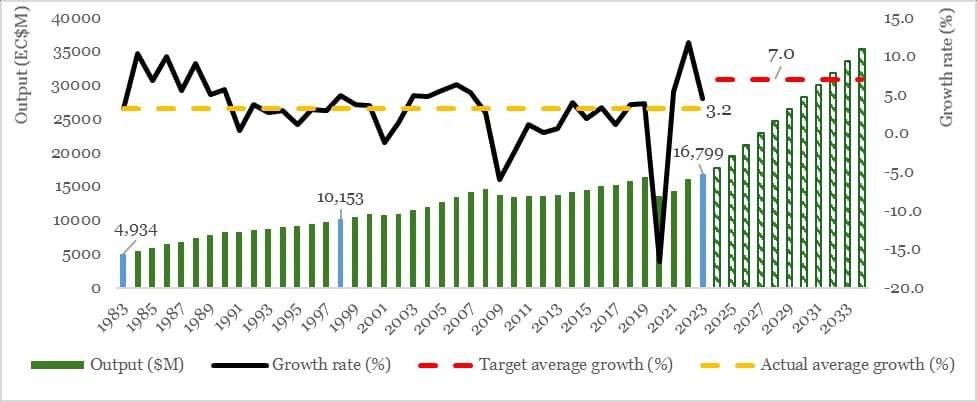
A historical perspective Doubling the ECCU GDP is not unprecedented. Since the establishment of the monetary union, economic output has roughly doubled from USD 5 billion in 1983 to around USD 10 billion in 1998.
Although GDP has exceeded its 1998 level, it has stabilised at around USD 17 billion due to various shocks and policy decisions.
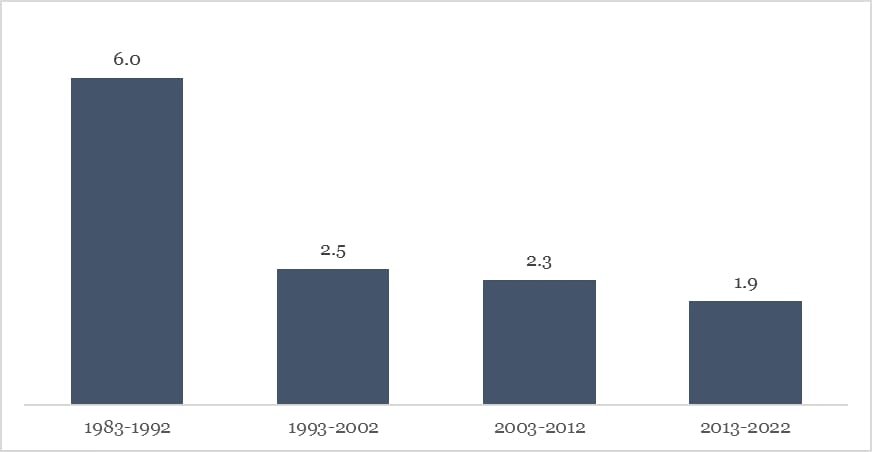
In addition, the forty-year period saw moderate average growth of 3.2 percent (see Figure 1), which has slowed down in each subsequent decade (see Figure 2). In the 1980s, real growth averaged 6.0 percent, supported by strong agricultural production and preferential trade agreements with Europe. Since then, average growth has fallen below 3.0 percent. A combination of factors has led to this slow progress.
The ECCU’s vulnerability to external economic shocks, natural disasters, and structural problems such as low economic diversification. Resulting in a heavy reliance on tourism and agriculture have led to high levels of public debt and infrastructure deficits, which hinder sustainable growth.
In addition, global financial crises and the slow pace of digital and technological integration have exacerbated these challenges and limited the region’s ability to fully capitalize on new economic opportunities.
What would a doubling of GDP mean for the monetary union?
GDP measures the total value of all goods and services produced within a country’s borders in a year. Despite the well-known limitations of using GDP as an indicator of prosperity, a doubling of GDP would
be a useful indicator of higher incomes and a higher general standard of living for households in the European Economic Area (ECCU).
A key objective is to reduce the wealth gap between the European Economic Area and the United States of America (USA) our largest trading partner, to which the EU dollar is pegged.
In 1983, per capita income in the USA was around USD 30,000 (US Bureau of Economic Analysis). The compared to USD 3,600 in the EU Economic Area (12% of US income). Today, per capita income in the United States is around USD. The 60,000 (US Bureau of Economic Analysis), while in the EU economic area it is around USD 9,000 (15 percent of US per capita income).
“Bracing for the Storm”
The goal for the coming decade is to converge more rapidly with US per capita income through inclusive socio-economic measures. The demand for a doubling of GDP is not a goal in itself.
It serves only as a tool for engaged dialogue and a promise of what is possible and necessary in the ECCU.
Without careful planning and implementation, we could achieve this ambitious goal, only to find that economic inequality has simply increased without any tangible improvement in the quality of life for people in the ECCU.
That would be both regrettable and tragic. Ultimately, this is about much more than an economic benchmark; it enables the expansion of opportunities for people in the ECCU, especially our young people.
Resilience:
A Built-in Mechanism A crucial key to overcoming the current production plateau is building resilience. Due to its geographical location, the ECCU is among the most vulnerable regions in the world. Over the past forty years, our region has been hit by numerous severe natural disasters. Following devastating events, countries have repeatedly entered a cycle of massive reconstruction efforts, resulting in fluctuating economic growth. A 2018 International Monetary Fund report titled “Bracing for the Storm” estimates that disaster losses. Expressed as a percentage of GDP, are 4.5 times higher for small states than for large states, but six times higher for Caribbean countries.
Furthermore, the Caribbean
Is seven times more likely to be affected by natural disasters than larger states and twice as likely as other small states (Ötker & Srinivasan, 2018, p. 49). The costs of these disasters are significant and are estimated to be in the billions of dollars. Sometimes, individual events exceed a country’s economic output, as was the case in Grenada (Hurricane Ivan, 2004) and Dominica (Hurricane Maria, 2017).
The region is increasingly vulnerable to extreme weather events, which are becoming more frequent and intense due to climate change. Comprehensive resilince strategies are needed to ensure that our economies can recover from such events.
Infrastructure: Resilience is as crucial as financial and human resilience. This includes building financial buffers against climate and disaster. Risks,strengthening preparedness mechanisms, promoting sustainable development practices, and ensuring that citizens have the necessary capacity to withstand and recover from such events.
“CLICK” for More